What is covered in class - How to study the material
When you are looking for Brazilian Jiu Jitsu classes, or beginner classes near you, make sure you try to match your learning style with the style of the school. It’s not necessary, but it can be helpful. Some academies are tournament heavy or sparring heavy. Others might be more traditional and laid back. There are many great places to train. It is a benefit to the beginner to get an idea of each academies approach.
Praxis is a curriculum heavy academy. We want you to train hard as soon as is practical for you. We also want you to know what you are doing, both to minimize injury and maximize chances of success. Good martial arts is efficient martial arts.
Our curriculum is a collection of concepts, principles, and techniques aimed at increasing your physical capability and understanding of Brazilian Jiu Jitsu. It is intended to be a generative approach to studying, practicing, and gaining skill.
Generative - not definitive. Definitive would be me telling you what works for you. Generative, in this case, means that in class we present what classically works well in Jiu Jitsu. The aim is for you, through work, to determine what your Jiu Jitsu will look like.
Information presented goes far beyond moves. The details of execution are based in the concepts and principles of the art. Moves, or techniques, are just one aspect of Jiu Jitsu. They are tools to accomplish a task - not cheat codes to hack a system.
Often people look to a system to guarantee a specific outcome. That is not martial arts. Martial arts is the study of conflict. When you study conflict you learn that it often has, at best, a zero sum aspect to it. A clear winner or loser. When you study conflict more you learn that there is generally a whole lot of losing that goes into each win. To study martial arts means to understand both sides of the coin.
Each move has a purpose, with most having at least two underlying assumptions; stay safe and don’t lose position. Keep that in mind - most moves are simply transitions through positions. Every move has a counter. Understand that concession is a big part of martial arts - meaning, how do you compose yourself when the move doesn’t go your way. In training, the sooner you can recognize that the tide isn’t going your way, the sooner you can respond appropriately.
There is no perfect system or method - there is you learning how to do Jiu Jitsu. You, personally, are going to have a unique set of attributes you bring to the table. One aim of studying Jiu Jitsu is to better understand how you, personally, best utilize resources and approach conflict.
Our generative approach is designed to help you develop movement fluency with the basics. Regardless of your desired aspirations and goals with Jiu Jitsu - having a firm grasp of the fundamentals will help you get there. Getting as many classes and cycles through the curriculum rotation is your path to progress.
Curriculum Rotation
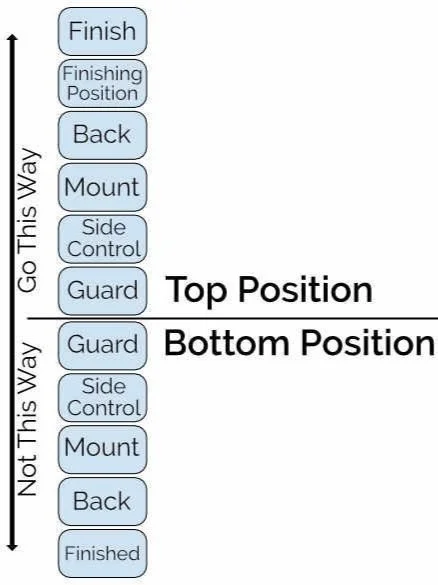
The Basic Jiu Jitsu Approach to Self Defense is the basis for all of our study. While, naturally, we study beyond basic self defense technique, we always anchor our study in the realities of that approach. Good sport and competitive Jiu Jitsu come out of the solid self defense capabilities of the art. A stong element in those capabilities is the concept of positional dominance within a positional hierarchy.
As an academy we focus on different elements of that positional hierarchy week to week and month to month. The length of time we spend in each area depends on many factors, but the general idea is to keep the bus moving. Once you miss material it is gone. We will revist the topics again over the course of the natural rotation, but you should try to get as many classes in as is practical. The set up of material is often unique and there is enough material to cover that it takes a fair amount of time before you will see the same thing covered again.
Most new students report being confused and lost over the first rotation, with things begining to click on the second rotation. A typical rotation may last 3-8 weeks. Focus on keeping yourself engaged, meaning, focus on what is fun for you. As long as your are working diligently on some aspoect of the art, time will eventually fill in the blanks. That said, the most growth is often found in the areas we avoid the most. To track your progress and make sure you get sound basics visit the Stripe Curriculum Checklists to assess what you do and do not recall from class.
Here are some of the topics and positions we will rotate though:
Back Defense
Safe Side Escape - Risky Side Escape - Scoop Escape
Back Offense
Taking the Back - Finishing Position
Turtle
Bottom - Recover Guard
Top - Follow Hips/Take the Back
Side Control Defense
Frame Escape Series - Pummel Escape Series
Side Control Offense
Take the Back - Take Mount - Finishing Positions
Stand Up
Clinch Basics: Pummel Series - Side Clinch - Thai Plum - Russian 2 on 1 - Arm Drag
Basic Foot Sweeps - Hip Throw
Guard Playing
Closed Guard - High Guard - Half Guard - Butterfly Guard
Guard Passing
Leg Drag - Knee Slice - Smash Pass
Over Leg - Under One Leg - Under Both Legs
Mount Defense
Buck and Roll - Knee to Elbow
Mount Offense
Triple Attack Concept: Armlock, Choke, Back Take
In the basic Jiu Jitsu approach to self defense we presented the positional heirarchy as shown below. You can study the material outside of class here, by matching the curriculum material above with the positional heirarchy below. Remember that positional thinking and techniques are just one way to dissect and study physical conflicts. In the end it is the physical conflict that matters. The more you get hands on practice - the better you will navigate conflict.